AI Wrappers Will Go to Zero
Thesis
Wrappers, apps and services built on frontier models are being squeezed from two directions:
- From above: Companies are building the functionality themselves, using foundation large language models (LLMs) and coding tools now available to any competent in-house team.
- From below: Foundation labs integrate the same use cases directly into the model layer, as a feature rather than a product.
Everything in the middle is going to zero, unless it has a genuine moat. I view this as three layers, squeezing the middle from both ends.
Layer 3: Customer Use Cases Will Be Developed In-house
AI coding tools have now made building software cheaper than the applications companies used to buy. This collapses the traditional model for hiring a System Integrator or an outsourced application development shop: why commission a six month build when a small internal team, working with Claude Code or an equivalent, can deliver the same workflow in a few weeks?
We are already seeing this showing up as a preference during earnings calls. CEOs are increasingly directly naming Anthropic when discussing how they're moving AI from pilot projects to their actual operational infrastructure.
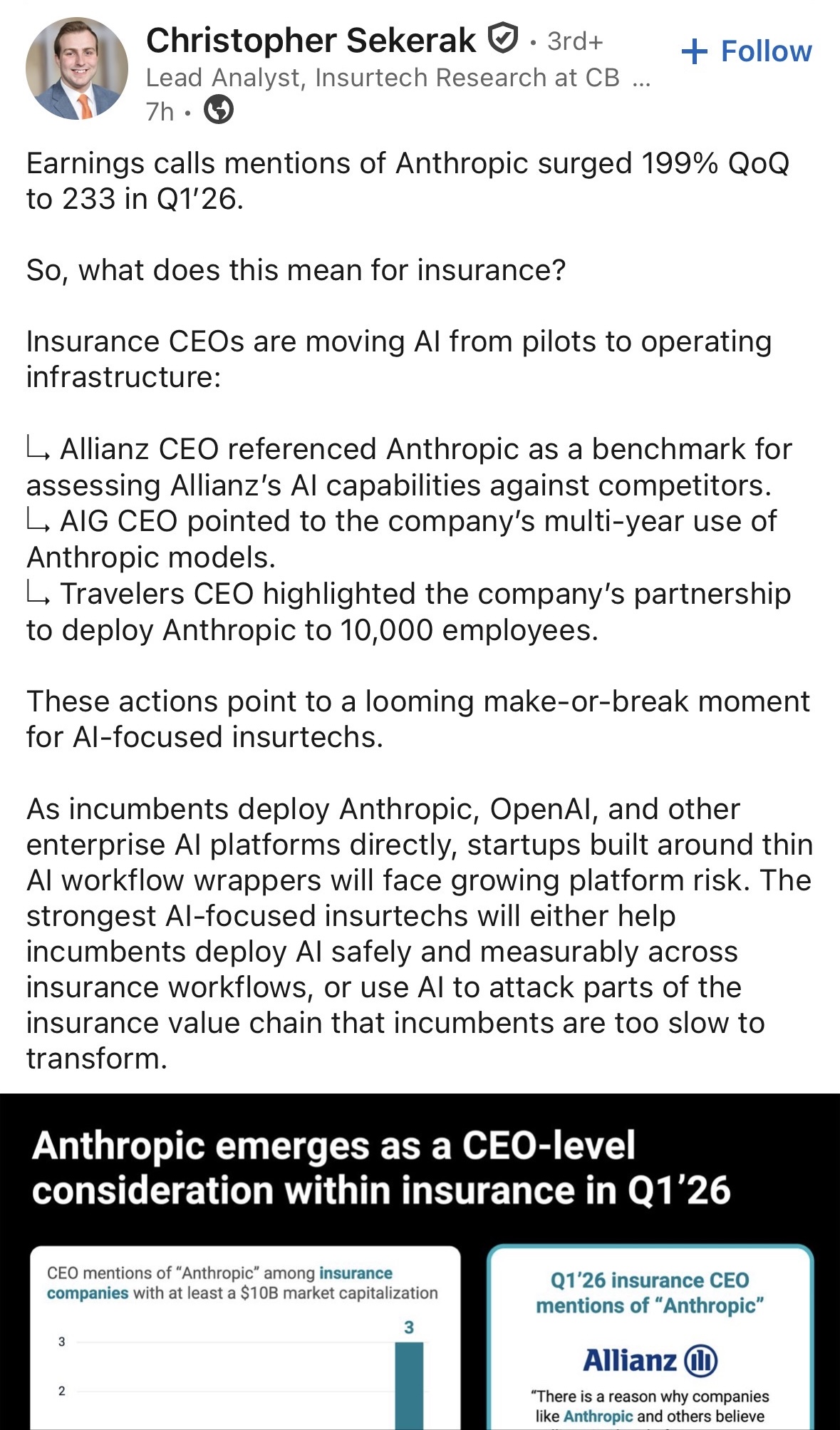 Insurance CEO quoting Anthropic during Q1 '26 earnings calls: Allianz, AIG, and Travelers all mention Anthropic as a reference or deployment partner
The insurance sector is a good illustration. Analyst tracking shows that mentions of Anthropic by CEOs during earnings calls have increased by 199% quarter on quarter in Q1 '26. The pattern behind this figure matters more than the number itself:
- Allianz's CEO cited Anthropic as a benchmark for measuring their own AI capability.
- AIG's CEO referred to a multi-year relationship using Anthropic models internally.
- Travelers' CEO described the deployment of Anthropic to 10,000 employees.
None of these companies are buying an AI insurance workflow product, they are buying the model and building the workflow themselves. That's the pattern to watch: companies moving directly to the foundation layer and building in-house, rather than buying a point solution from a startup sitting in between.
Layer 2: AI Wrapper Apps Have No Intrinsic Moat
This is the layer that is getting crushed.
Most AI applications built on foundation models have very little defensibility. The intelligence is entirely borrowed from the underlying LLM, and the interface surrounding it (the part built by a startup) can generally be reproduced in an afternoon with modern AI coding tools. If your product is a nice UX in front of an API call, that used to be a real value proposition. It no longer is because the cost of building a nice UX in front of an API call has collapsed to nearly zero for everyone including your customers and the model provider itself.
A moat can still exist at this layer, but it must be genuinely difficult to reproduce, not just currently unreproducible. In practice, this boils down to two capabilities:
- Proprietary data that neither the model provider nor the customer already possesses: no scraped or licensed data that anyone can buy, but data generated by owning a real and continuous process (transactions, sensors, proprietary workflows).
- Deep interfaces and integrations into a customer's systems and workflows that are genuinely painful to rebuild: not a dashboard, but a depth of integration that has required years of institutional trust and access to earn.
Everything short of this is a thin layer of UI sitting on someone else's intelligence, and thin layers are becoming commoditised quickly.
Layer 1: Foundation LLMs Will Keep Absorbing End-User Functionality
Labs aren't staying at the model layer either, they're moving up the stack into the exact use cases startups were building products for.
Anthropic's own work makes this explicit, as an example they've released a set of reference agents that are equivalent to a functional financial brokerage house running inside Claude: pitch decks, market research, general ledger reconciliation, each shipped both as a Cowork plugin and a deployable agent template.
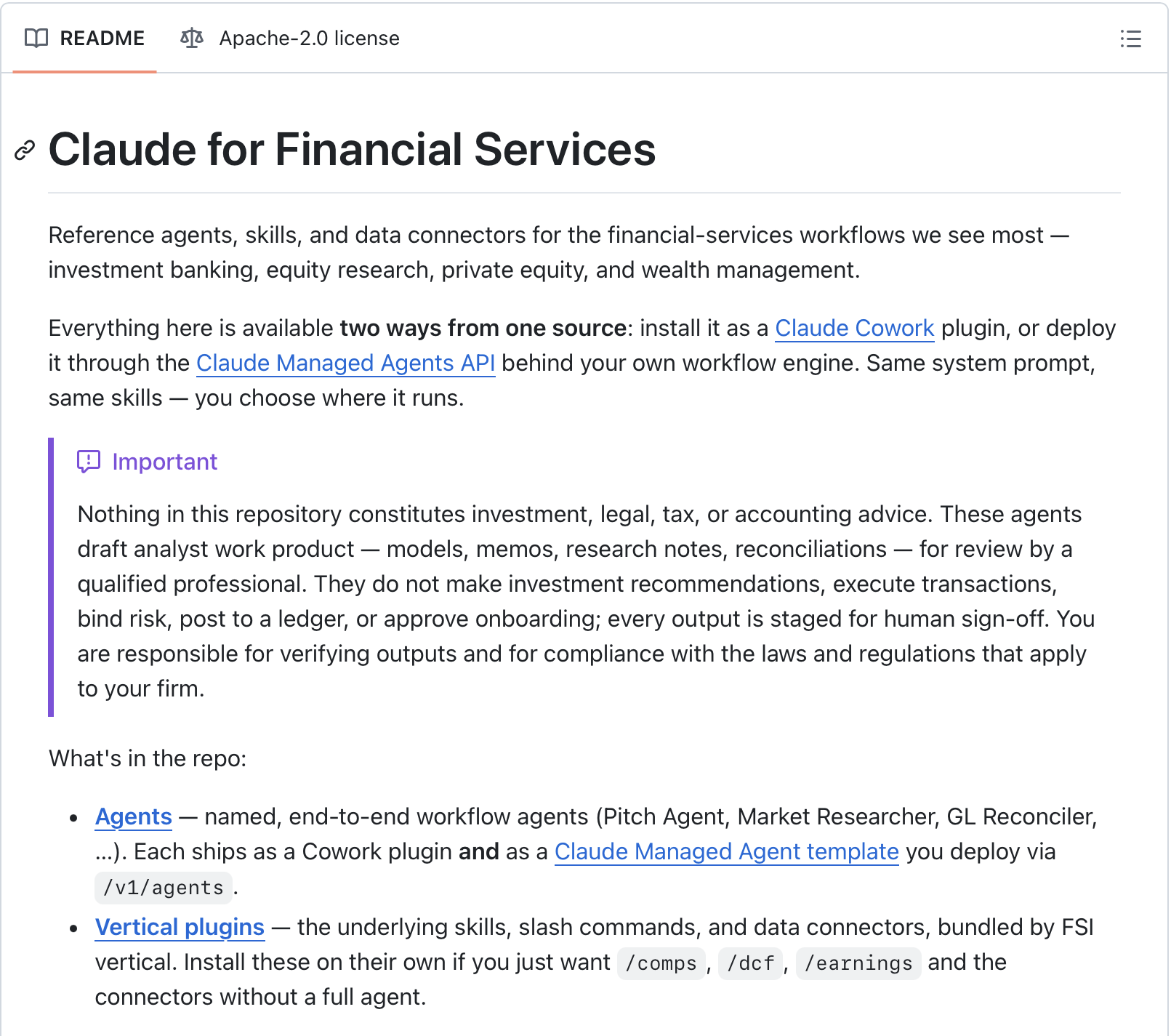 Claude GitHub Repository for Financial Services: reference agents, tools, and data connectors for investment banking, stock research, private equity, and wealth management workflows
Connect it to your data sources, add your compliance rules, and you have most of a functional trading operation stack, without ever buying a fintech "wrapper" product. This is already delivered under the Apache open source licence and available today.
The same pattern is evident in B2C, Virgin Atlantic recently connected its booking system directly to ChatGPT and so allowing a traveller to search and compare flights in a conversation instead of opening the Virgin Atlantic app.
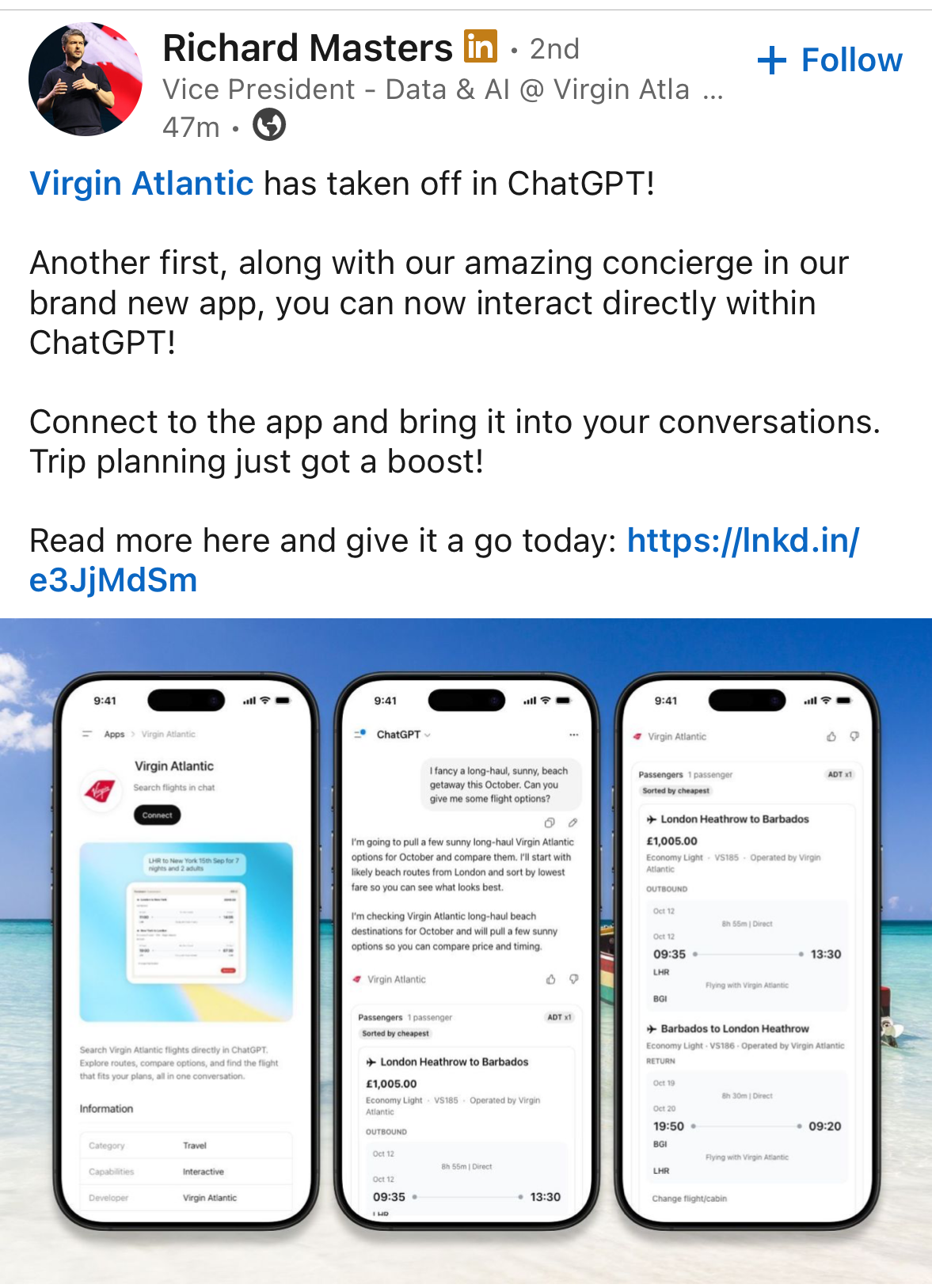 Virgin Atlantic connects flight search directly to ChatGPT; travel planning happens in the model conversation, not in a separate application
This is a living example of the model layer entirely absorbing the app layer. The value doesn't move towards a slick travel wrapper; it moves to the foundation model the customer is already using. The airline's work is about plugging its inventory directly into this conversation.
Two directions, one squeeze: companies build it themselves from above, and foundation labs deliver it as a feature from the below. What remains needs a real reason to exist.
Market Signals: This is Already Reflected in Headcount
As model capability increases, software vendors face growing pressure to reduce costs and defend their existing customer base before someone else or an internal team or the model provider itself—does it for them.
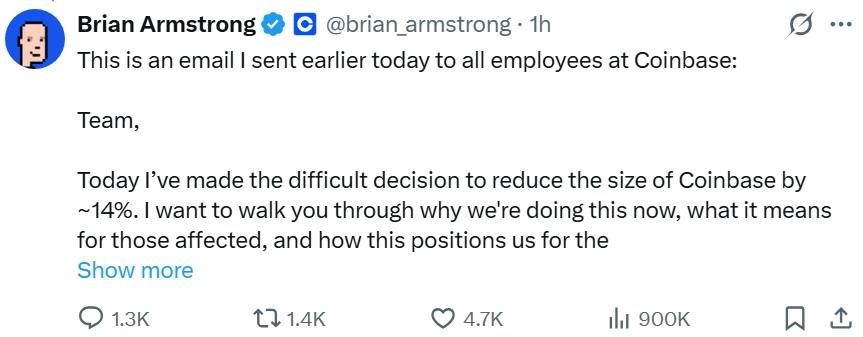 Brian Armstrong's email to Coinbase staff announcing a 14% headcount reduction, attributed to AI restructuring
Coinbase is a clear example. Brian Armstrong reduced the company by about 14%, equating to around 700 people, while pushing "native AI pods," some built around a single person paired with AI agents, replacing pure management layers with "player coaches" who both lead and individually contribute.
Coinbase is not isolated. The same logic (smaller teams, AI absorbing work, payroll following) is evident across the entire industry:
- Shopify: No new hires approved unless the team can prove that AI truly cannot do the job.
- Block: Reduction of about 4,000 positions (~40%); Jack Dorsey's justification is that AI allows much smaller teams to do more.
- Klarna: Its AI assistant now performs the equivalent of about 700 support roles.
- Duolingo: Switched to AI first model instructing teams to rebuild workflows around AI before asking for headcount.
- Salesforce: Suspended new engineer hires after AI tools increased developer productivity by about 30%.
- Amazon: Reduction of about 16,000 corporate positions this year as part of an efficiency and automation push.
- Meta: Reduction of about 10% of personnel and freezing thousands of open positions while doubling investments in AI.
Independent research estimates that the current pace sits somewhere between 800 and 900 tech sector jobs disappearing per day. The visible edge of the same squeeze happening at the organisational level: less need for people whose job was to build or exploit the layer that is disappearing.
What This Means If You Are in the Middle
If your company is a layer between a foundation model and a customer, the question to ask yourself is not how good is our AI, everyone's AI is the same AI. The question is: what do you possess that Anthropic, OpenAI, or your client's engineering team cannot trivially replicate?
- Do you possess data that neither the customer nor the model provider truly has access to?
- Is your integration into their workflow deep enough that its reconstruction is a real project, not a weekend task?
- If none of these conditions are true, is there any reason for the customer not to build this themselves with an internal team and an AI coding assistant next quarter?
Building on foundation models isn't the problem a thin interface to one is. The companies that will survive this squeeze will be those that have a moat that has nothing to do with the model itself.